
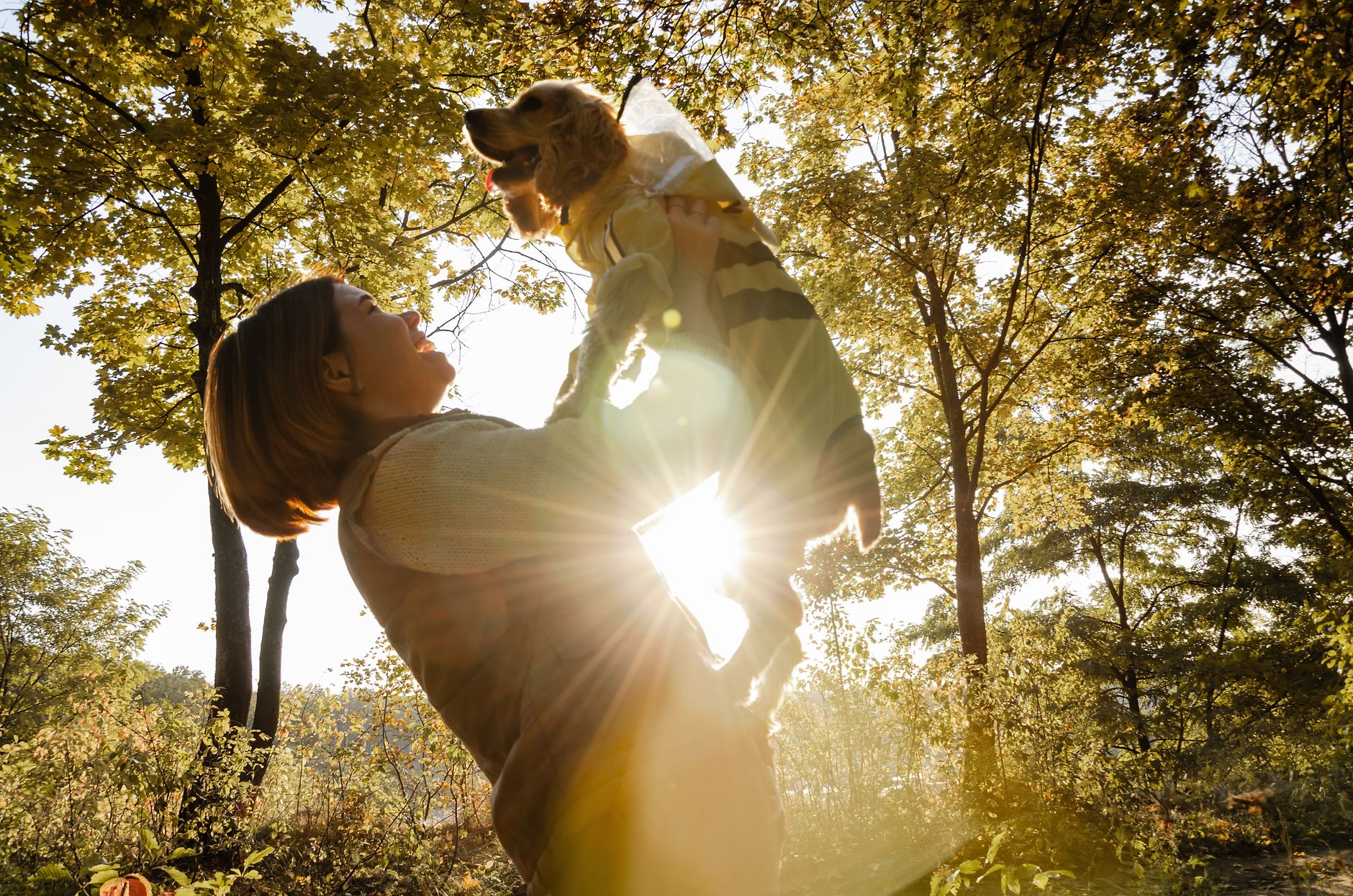
There comes a point with a big dog where the car, the couch or the back steps stop being manageable. Most households solve it by lifting, and most people lift badly, usually under the belly, usually in a hurry. Done well it is safer for both of you. With a ramp, often it need not be done at all.
How to lift, properly
The principle is to support the chest and the hindquarters at the same time, keeping the spine level, and to let your legs do the work.
One thing first: if you think your pet has hurt their back, do not encourage them to stand and do not let the spine bend. Keep the back level, support it along its length, and call us before you move them any further than you have to.
- Get them standing first if you can, rather than scooping from lying down.
- One arm around the front of the chest, in front of the front legs, not under the throat.
- The other arm behind the back legs, under the thighs rather than under the belly.
- Bring them against your body before you straighten up, so the weight is close to you.
- Lift with your legs, back straight, no twisting. Turn with your feet rather than your waist.
- Set them down front feet first, so they can find their balance before the back end lands.
What to avoid: lifting under the belly alone, which lets the spine sag and presses on the abdomen, which matters if there is anything going on in there; lifting by the front legs or armpits, which puts all the load on the shoulders; and picking up a dog who is in pain without warning them, which is how people get bitten by their own dog.
For a dog over about fifty-five pounds, use two people or use equipment. Nobody wins a contest with a large dog on a staircase.
When a ramp is the better answer
A ramp removes the lift entirely, which is better for the dog’s joints and for your back. It is the single most useful piece of equipment for a large older dog.
- Length matters more than anything. A short, steep ramp is harder than the jump it replaced. Longer and shallower is always better.
- Non-slip surface, and side rails if your dog is unsteady.
- Stable at both ends. A ramp that shifts once will not be used twice.
- Introduce it flat on the ground first, with something good at the far end, before any incline. Most ramp failures are introduction failures.
- Steps suit small dogs and cats better than ramps in general, and take up less room. One exception matters: a long-backed breed (a dachshund, French bulldog, Shih Tzu, Pekingese or beagle) is better with a ramp, because steps still ask for the hop and the flex that a ramp removes.
Indoors, the cheaper fix is traction. Runners along the routes a dog uses most, bed to door and bed to bowl, do more for a wobbly older dog than most owners expect, because slipping is both a cause of injury and a reason dogs stop moving.
A harness with handles
For dogs who need help on stairs or getting up, a support harness with a handle over the hips, or a full-body one, lets you take part of the weight without bending into an awkward lift. It is a far better solution than a towel under the belly, which concentrates pressure in exactly the wrong place.
Get one fitted properly. A harness that slips is worse than none, and the right type depends on whether your dog needs help at the front, the back or both.
What the need for lifting is telling you
A dog who suddenly needs help has had something change, and it is worth knowing what. Discomfort in the hips, knees or back is the common answer, but weakness from something else entirely can look identical from across the room, and the two are managed very differently.
Our medical services cover that examination. Pet diagnostics supports that work: imaging and blood work rule in or out what the examination suggests, and we refer on when a spinal cause needs advanced imaging. A wellness visit is where this gets caught early in a senior dog, and twice a year makes sense once they are into that stage. Nutrition counseling belongs in the conversation too, because every extra pound goes through the same joints.
Signs it is more urgent than equipment
- Sudden inability to use the back legs, or dragging a paw.
- Crying out when lifted or touched in a particular place.
- Knuckling over on a paw rather than placing it flat.
- Weakness that came on over hours rather than months.
- Loss of bladder or bowel control alongside hind-end weakness.
Those are not ramp problems. They need to be seen immediately, not the next day, and not the next morning if it happens overnight. If we have closed, go straight to Ocean Avenue Veterinary Hospital, whose details are below.
Our hours
We are open every day, Monday through Sunday, from 8:00 am to 7:00 pm, with a licensed veterinarian on the premises whenever we are open.
Mobility is a booked appointment and worth allowing time for. Anything on the list above needs same-day attention. If we are closed, go to Ocean Avenue Veterinary Hospital, a 24-hour facility at 1001 Ocean Avenue in San Francisco, reachable at (415) 586-5327.
Common questions
My dog used to jump into the car and now refuses.
That is usually the first visible sign, and it is a good moment to book rather than to start lifting.
Is it bad to let them keep jumping down off the couch?
Jumping down is harder on the front end than jumping up is. A step there is worth more than most people think.
Can I use a towel as a sling?
In an emergency, yes. As a routine it presses on the belly and gives poor control, so a proper harness is better.
Will a ramp make them lazier?
No. It removes a high-impact movement and usually results in a dog who moves more overall, not less.
What about cats?
Steps up to a favorite perch or windowsill, and a litter box with a low entry. Cats rarely accept ramps but take to steps readily.
Speak to the team at Daly City Pet Hospital
If you are already lifting your dog daily, book a visit rather than buying equipment first, because what is behind it changes which equipment helps.
Published by the team at Daly City Pet Hospital.
This article is for general educational purposes only and is not a substitute for an in-person veterinary examination or advice about your individual pet. If you have an urgent concern about your pet, contact Daly City Pet Hospital or your nearest emergency veterinary hospital right away.
Daly City Pet Hospital
170 Skyline Plaza, Daly City, CA 94015
Phone: (415) 859-5676
Hours: Monday to Sunday 8:00 am to 7:00 pm